Sounds of falling objects, bark dogs and football legs ... How to be if another attempt to sleep on a long-awaited day off with a crash failed? To protect yourself from annoying foreign sounds that are coming from the neighbors from above, it is enough to sound the ceiling overlap.
1
To perform reliable and high-quality sound insulation below the level of the apartment ceiling, an additional ceiling system is mounted. The least sound-conducting is the design of the tension type. They perfectly absorb extraneous noise, they differ in stylish design and quickly mounted. However, with all the advantages, such ceiling systems have several drawbacks - without the involvement of specialists, it is practically unrealistic to pull the perforated ceiling canvas correctly (such installation involves the presence of special equipment), and the cost of materials is quite high. A more affordable, but no less effective option for noise insulation of the ceiling is the arrangement of a multilayer frame structure.
2
The soundproofing process starts with careful preparation of the base. The first thing from the ceiling remove the remains of old finishing materials (whitic, wallpaper, paint) and glue. The ceiling surface is then treated twice with waterproofing primer. To eliminate the irregularities and curvature of the base, a spacinal solution is used, and for embedding cracks, cracks and other defects - a special acoustic sealant. Next, the ceiling overlap is covered with sound insulation felt or polymer membrane. For additional fastening of the material use dowels-umbrellas.
3
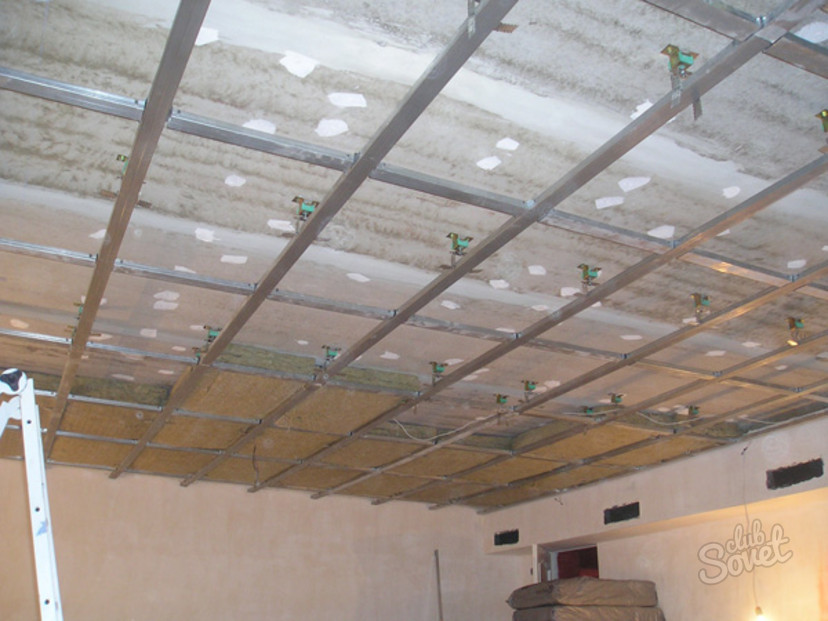
The next stage of work is the installation of the suspended frame design - begin with marking the ceiling surface. An indentation from the ceiling slab should be greater than the thickness of the soundproof by 3-5 mm - this height is necessary for the proper placement of the material in the crate and ventilation gaps. Next, according to the markup to the walls, the guide profile is attached - no less than three point of attachment should have for each rail. After that, the framework is mounted - with parallel laying, the step of 40-45 cm is kept, with perpendicular - 55-60 cm. To avoid the appearance of vibration noise, all construction fasteners are necessarily compacted using rubberized gaskets.
4
Next, begin to fill the cavities with a soundproof material. Most often, at mounting of suspended plasterboard ceilings, mineral wool is used (fiberglass, basalt plates and cork panels are also used as sound insulators). Materials are placed in the frame section as evenly and tightly and tightly, but not allowing the deformation (friction) of the insulator. At the same time controls that the air intermediate layer remains between the felt / membrane and the minivata. An important nuance: when performing installation work, fabric gloves are used, safety glasses and a respiratory mask to avoid irritation of the respiratory tract.
5
The heating of plasterboard sheets start from the angle of the room. Until the installation, the material is kept in a horizontal position for at least 2-3 days. First, one-piece panels are attached to the frame profiles, the last turn is cut. Self-tapping screws are used for fastening the material. Between the sheets, there are gaps in 2 mm, between sheets and walls - 4-5 mm. Such indents are necessary to compensate for the temperature expansion of drywall. All sheets of sheets are sampled with a sound insulation ribbon, processed with primer and close with a suture putty or moisture-resistant mastic. Then sweat the entire area of \u200b\u200bthe suspended ceiling. After a complete solution of the solution with fine sandpaper, all irregularities of the coating are grinding. The final barcode is the finish finish of the ceiling surface.
Remember that the ceiling sound insulation is most effective within complex noise insulation apartment. Walls of the room, floor, windows, doors and even sockets are the same conductors of unwanted noise, like the ceiling overlap.
Share advice:"How to make the noise insulation of the ceiling"




 0
0 1012
1012