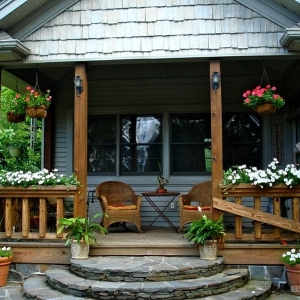
Now it is very difficult to imagine a modern country house without a canopy or canopy over the porch. This extension protects from the elements and is a stylish decoration of the main entrance. If desired, a practical hinged structure can be built with their own hands without the involvement of specialists. For information on how to do this properly, we will cover in this article.
1
In fact, the whole overhang installation process consists of three stages - preparation of drawings, manufacturing a suspension frame construction and laying of roofing material. Various materials are used for manufacturing the carcass - wood, aluminum, metal angles, steel pipe and forged elements, but practice shows that the optimal solution for the construction of the carcass structure is a galvanized metal profile.
2
As for arrangement of roofing material visors and awnings may be used steel sheets, corrugated PVC plates, metal or shingles. Recently, very popular among consumers enjoys polycarbonate - this modern material is characterized by the following specifications:
durability;
fire;
flexibility;
ease of installation;
excellent light transmission;
UV resistance and temperature differences;
broad color palette;
relatively low cost.
3
So, for the construction of The single (direct) shed you will need the following tools and supplies:
tubes of metal sheets;
polycarbonate (preferred thickness - 8.10 mm);
an end profile;
fixing elements (anchor bolts, screws with thermowasher);
primer and paint for metal for the frame opening;
welding apparatus, a drill and a screwdriver;
circular saw, jigsaw or handsaw;
tape measure and level.
4
To calculate the exact amount of materials necessary, make a pre-drawing design. When designing, take into account that the optimal length of the visor, which does not require additional strengthening with vertical support racks - 80-90 cm. As for the width of the canopy, it should be more doorway width of about 70-80 cm. In order for the visor to be delayed. It should be slightly low (recommended slope - at least 15-20 degrees).
5
The next stage of work is the manufacture of a frame base. With the help of welding equipment, assemble, according to the scheme, harvested elements into a single design (if desired, several transverse jumpers can be installed between the beams - they significantly increase the strength, stability and rigidity of the canopy). At the end of the welding work, clean the resulting seams from the scale with sandpaper and drill the holes drill under the fasteners (there must be four mounting points: the first two are in the upper horizontal angles, the second two are at the bottom of each vertical rack). Next, the collected bearing reason fix on the wall with reliable anchor bolts. After installation, handle the framework of the primer and open the paint twice.
6
After fixing the frame base, proceed to laying polycarbonate. In advance, prepare the workpiece of the required size (cutting out the sheets exclusively on a flat solid surface to eliminate the vibration of the material - otherwise not to avoid the appearance of microcracks and chipping). The fastening of polycarbonate blanks to a frame basis is made using special tapes with thermoshabami. Holes under the fasteners must exceed the diameter of the screws for 2-3 mm so that the plastic can "play" when the temperature drops. The optimal distance between the holes is about 30 cm. Tighten the fasteners as smooth as possible so as not to damage the edges of the plastic panels. Be sure to use gaskets and plugs for fasteners to prevent metal rusting.
7
Consider that the shelves of roofing material cannot be attached to the principle - they should be located with a small gap (about 2-3 mm). Upon completion of the installation work, a protective film is removed from the polycarbonate, and the edges of the sheets are closed with an end profile or are sampled with a special perforated ribbon. Such sealing will prevent the clogging of empty cavities of the material and the condensate in them.
So you can independently build a concise canopy over the porch of the house. Do not forget to periodically clean the surface of the visor from dust, garbage and precipitation.
Share advice:"How to make a canopy over the porch"


 0
0 1085
1085