The establishment of paternity is a serious legal action that determines the legal relationship between a minor child and his father. The need for such a procedure arises for various reasons: the desire of the mother to get the right to alimony from the child's biological parent or, for example, in the occurrence of inheritance disputes. Consider the detailed features of confirmation of such legal relations.
Today, there are quite common situations when it is necessary to establish the fact of the origin of the kid on the paternal line:- If he is born in civil marriage, i.e. Relationships of blood parents were not officially registered in specialized bodies.
- In the case when the mother of the crumbs, being in an official marriage, gives birth to him from another man and wants to legalize the relationship between the baby and his biological parent.
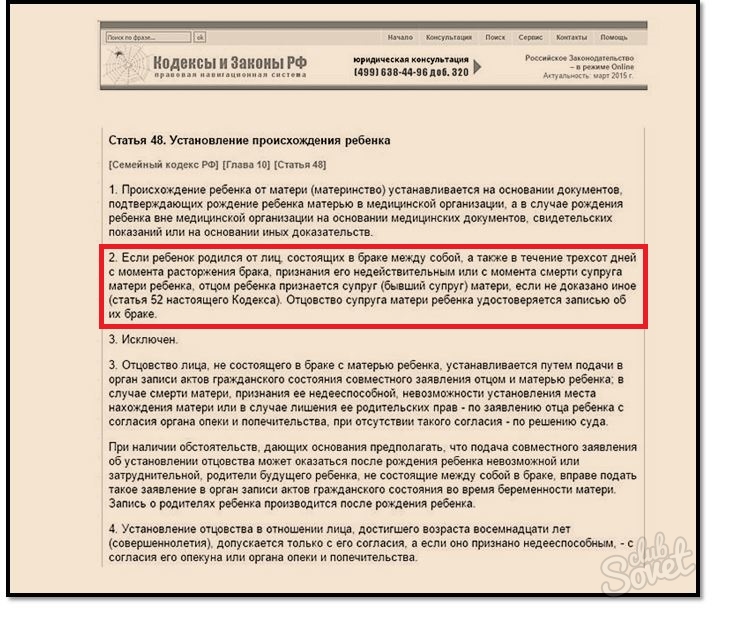
It is necessary to add that paragraph 2 of Art. 48 of the RF IC defined the legal phenomenon that received the "presumption of paternity", i.e. By default, the father of the child admits:
- A man who is a mother's wife's wife by law.
- The former or deceased husband's mom's mother, if after termination or cancellation of marriage, as well as the death of the spouse passed less than 300 days.
It is possible to challenge the presumption, but only by contacting the court with the relevant statement.
- pre-prepare documents certifying the identity of the applicants, and the receipt of payment of state duty;
- contact the registry office at the place of registration of the baby or at the place of residence of one of the parents;
- submit and register a joint statement of the approved sample (paragraph 3 of Art. 48 SC).
Download on our site:
 Joint application for paternity;
- An example of a joint statement statement;
- Statement Father's Fatal Statement;
- An example of a father's claim for paternity;
- Application for the recognition of paternity on the basis of a court decision;
- An example of a filled statement on the recognition of paternity by the court decision;
- Typical application for the recognition of paternity after the death of the parent;
- An example of a filled statement on the recognition of paternity after the death of the parent.
- When both parents do not have the opportunity to be present in one place. In these circumstances, the submission of two statements is permitted - one from each of them.
- If there are reasonable reasons for submitting an application for the recognition of paternity to the birth of a child. The Family Code of the Russian Federation provides such an opportunity by filing a "preliminary" statement.
- In certain cases, paragraph 3 of Article 48 of the SC, the individual statement of the Father is allowed.
As a rule, a paternity recognition document is issued on the applicants' day. The procedure is much simplified in the case of the mutual consent of the parents.

In this order, it may require the establishment of origin (art. 49 SC):
- parents kid;
- guardians crumbs;
- adult child;

- go to the district court at the place of residence;
- prepare a statement in free form with the presentation of the requirements for the recognition of the child's origin from a particular person;
- attach documents that are evidence of the biological relationship between a man and a child.
The statement of claim is based on the general rules of office work:
- In the "Shapka" of the document, specify: the name of the judicial institution in which your personal information about the plaintiff and the defendant.
- In the center write "the statement of claim" and proceed to present the circumstances of the whole case.
- Specify the request - to recognize the child with the child a concrete person.
- Finance the list of documents attached to it.
- Put your own signature.
 Claim for paternity here.
An example of a filled claim for paternity here.
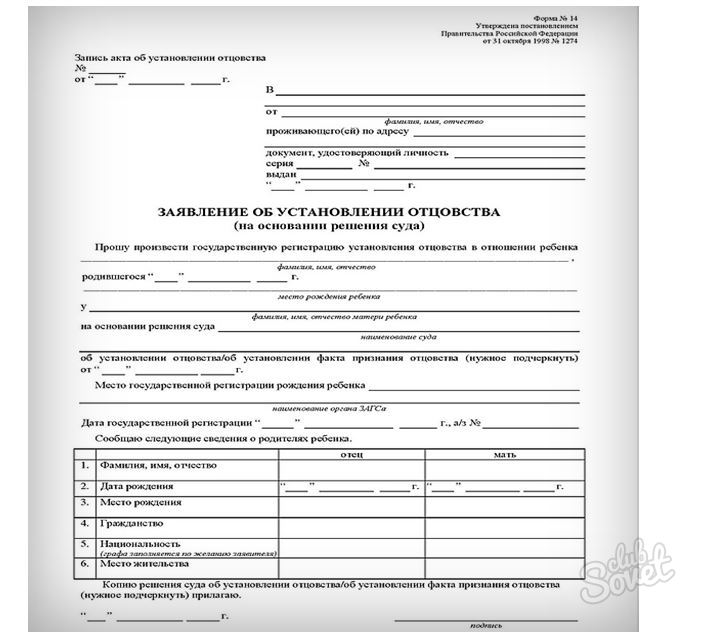

It is necessary to add that if the claimant's claims satisfying the confidence in the parental and the child should apply to the court decision and the statement of the above-mentioned sample into specialized bodies (registry office) to register the judicial establishment of paternity.

 0
0 1650
1650