
Cosine is one of the main trigonometric functions. According to the definition, this value is a numerical expression of the ratio of the adjacent category (in a rectangular triangle) to hypotenuse. To find the COS value of the angle, you can use the data on the sides of the triangle, formulas by bringing or trigonometric identities. With each way to get acquainted in more detail below.
Finding the cosine value by definition
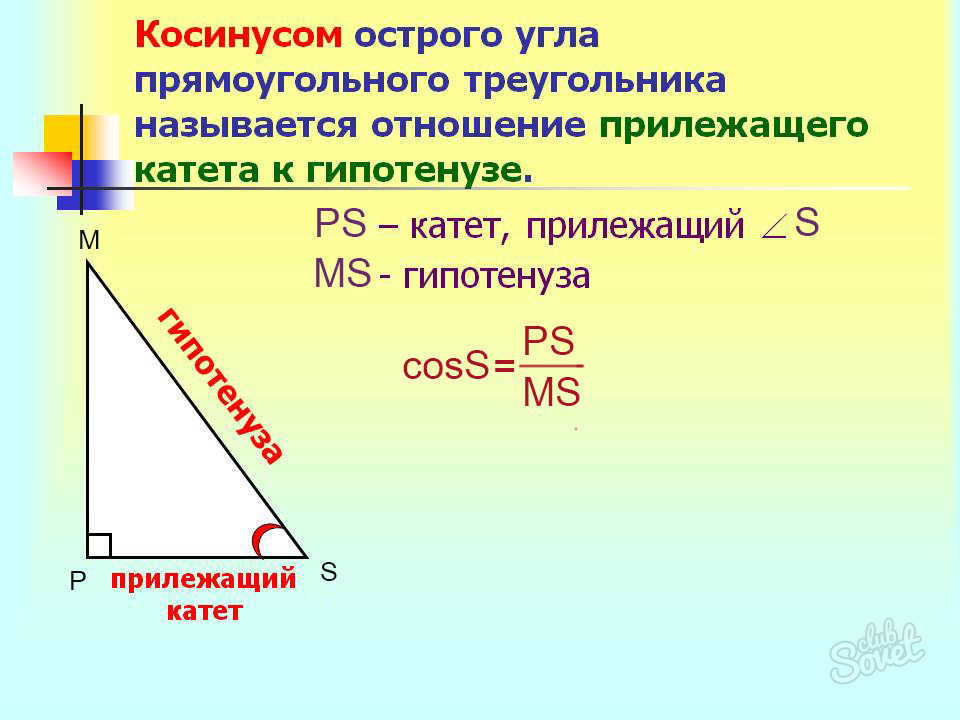
The definition of cosine "binds" this trigonometric function with a rectangular triangle. So, in front of you the specified figure is the MSP triangle, ∠p \u003d 90 °. Then:
- cOSM \u003d MP / MS,
- cOSS \u003d PS / MS, where
- MP and PS are adjacent (for each specific angle) cathets,
- MS - hypotenus of a given triangle.
Finding the cosine of the corner between vectors
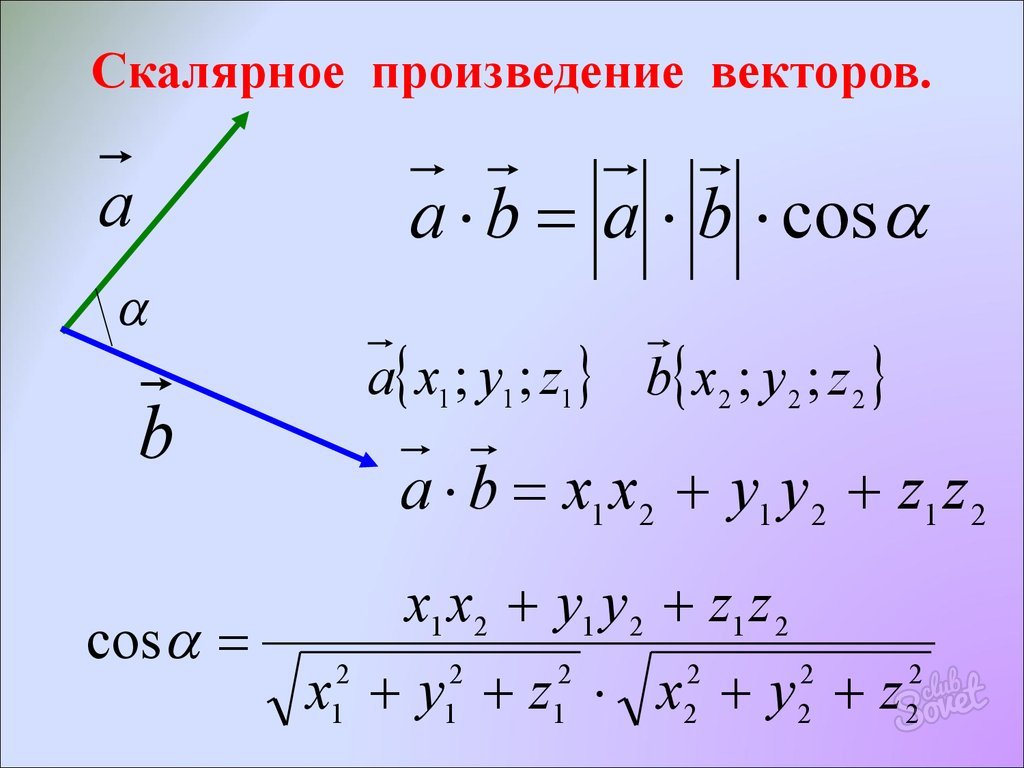
The intersection of directed segments of straight - vectors - leads to the formation of angles. Find their cosine (and, it means, in subsequently, the degree of measure) allows the definition of a scalar product of vectors. This wording involves multiplying the lengths of the vectors on the cosine angle formed as a result of their intersection. So., if you have 2 directed segments ū and ō, then
- ōō \u003d ū * ō \u003d (ū, ō) \u003d lūl * lōl * cos (ū, ō), ⇒
- cOS (ū, ō) \u003d (ū, ō) / Lūl * Lōl.
- In the projection on the coordinates of the Cartesian system, the directional segments have parameters ū (x, y) \u003d (u (x), u (y)) and ō (x, y) \u003d (o (x), o (y)). So the ratio takes the following form:
- cos (ū, ō) \u003d (u (x) * o (x) + u (y) * o (y)) / lūl * lōl \u003d (u (x) * o (x) + u (y) * o (y)) / (√ (u (x) 2.+ U (Y) 2) * √O (x) 2 + o (y) 2).
If the directional segments are not specified on the plane, but in space, the third coordinate is added - z. The expression of the location of the cosine is converted and will have the following form:
cos (ū, ō) \u003d (u (x) * o (x) + u (y) * o (y) + u (z) * o (z)) / lūl * lōl \u003d (u (x) * o (x) + u (y) * o (y) + u (z) * o (z)) / (√ (u (x) 2.+ U (Y) 2 + U (z) 2) * √O (x) 2 + o (y) 2 + o (z) 2.
Finding the cosine variance using the formula
Working with cosine formulas for cosine, it is necessary to understand and remember the important rule - the transition from the function to cofunction (in this case, the transition from COS to SIN) occurs at 90 ° and 270 °. At 180 ° and 360 ° there will be no such transformation. Based on this, the following ratios will be fair:
- cos (π / 2 - μ) \u003d sinμ,
- cos (π / 2 + μ) \u003d -sinμ,
- cos (π - μ) \u003d cos (π + μ) \u003d -COSμ,
- cOS (3π / 2 - μ) \u003d -sinμ,
- cos (3π / 2 + μ) \u003d sinμ,
- cos (2π - μ) \u003d cos (2π + μ) \u003d cosμ where
- μ - angle of rotation.
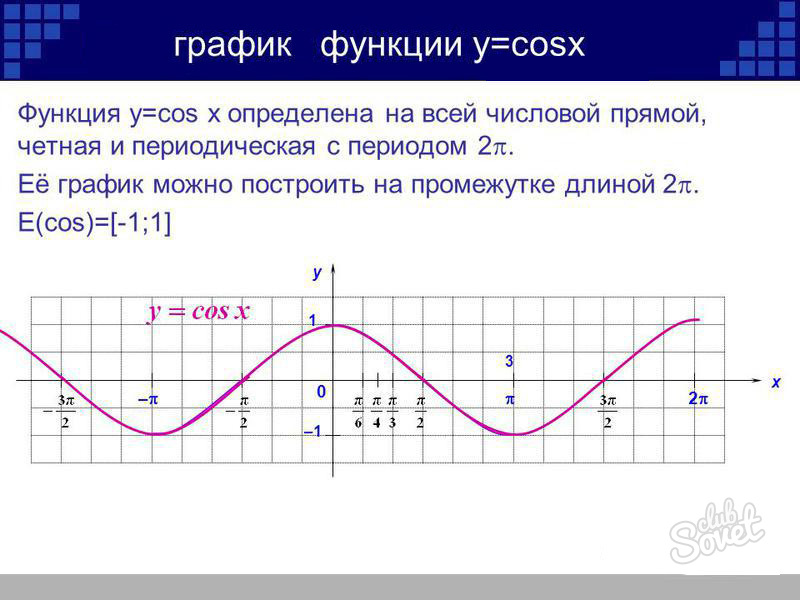
Because The cosine is a periodic function with a period of 2πk, where k is an arbitrary integer, in general, the expression of the lead will acquire the following form:
- cos (μ + 2πk) \u003d cos (-μ + 2πk) \u003d COSμ,
- cos (π / 2 - μ + 2πk) \u003d sinμ,
- cos (π / 2 + μ + 2πk) \u003d -sinμ,
- cos (π - μ + 2πk) \u003d cos (π + μ + 2πk) \u003d -COSμ,
- cOS (3π / 2 - μ + 2πk) \u003d -sinμ,
- cos (3π / 2 + μ + 2πk) \u003d sinμ,
- cOS (2π - μ + 2πK) \u003d COS (2π + μ + 2πk) \u003d COSμ.
Finding the cosine variable through trigonometric identities
These identities are expressions (equality), fair for an angle of any degree measure.
- cos. 2μ + SIN 2μ \u003d 1 ⇒ COS 2μ \u003d 1 - SIN 2μ ⇒ cosμ \u003d ± √ 1 - sin 2μ
- tGμ \u003d SINμ / COSμ ⇒ COSμ \u003d SINμ / TGμ
- cTGμ \u003d COSμ / SINμ ⇒ COSμ \u003d CTGμ * sinμ
- 1 / Cos. 2μ \u003d TG. 2μ + 1 ⇒ COS 2μ \u003d 1 / (TG 2μ + 1) ⇒ COSμ \u003d ± 1 / √TG 2μ + 1.

Finding the Cosine Corner - Table Battoos
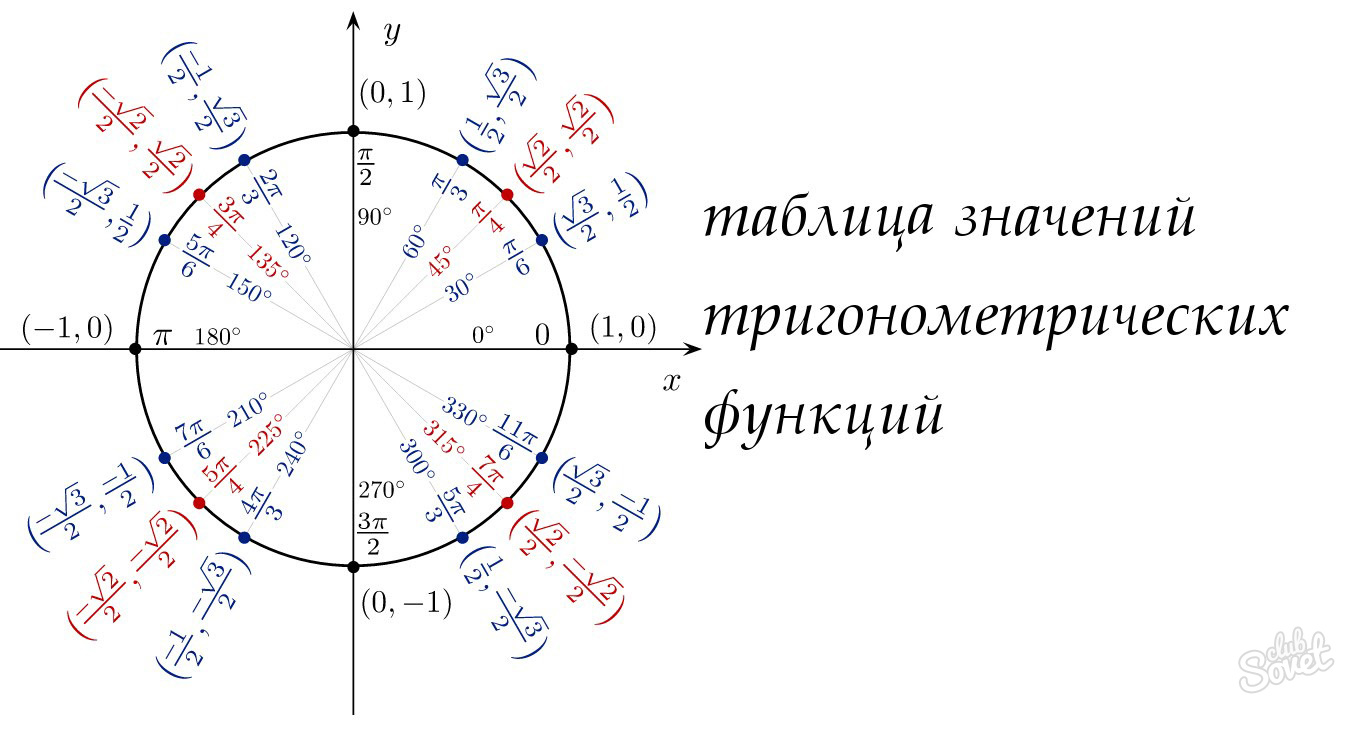
For each angle, the degree of which is located between 0 ° to 360 °, can determine the corresponding cosine value, using the table of the same name. The most common and frequently used are the following constants:
- cos0 ° \u003d 1, cos90 ° \u003d 0,
- cOS30 ° \u003d. √3 / 2, COS180 ° \u003d -1,
- cOS60 ° \u003d 1/2, COS360 ° \u003d 1.
- cos45 ° \u003d √2 / 2,


 349
349